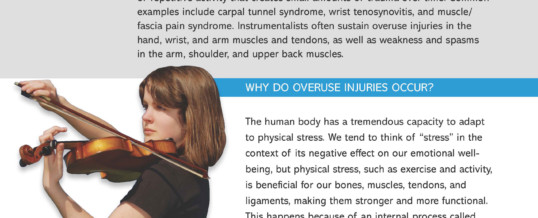
There are basically two types of injuries: acute and overuse. Acute injuries are usually the result of a single, traumatic event. Overuse injuries, on the other hand, occur to tendons, muscles, joints, and other tissues as a result of repetitive activity that creates small amounts of trauma over time. Common examples include carpal tunnel syndrome, wrist tenosynovitis, and muscle/fascia pain syndrome. Instrumentalists often sustain overuse injuries in the hand, wrist, and arm muscles and tendons, as well as weakness and …
View Permalink ShareSubmitted by Music Teachers National Association (MTNA)

MTNA webinar by Christine Guptill
Streamed live on Oct 21, 2016
Since many musicians’ injuries are related to practice habits, music teachers can and should play a vital role in injury prevention from the start. This webinar offers some clinical and research-based information to help teachers and students identify risks and prevent problems before they start.
https://www.youtube.com/watch?v=o_jDNaVRdPM
The use of detailed orthopedic imaging to examine dancers’ ankles while in the en pointe position offers insight into the biomechanical demands associated with a position that, although highly unnatural, is nevertheless essential to a ballerina’s performance.
Read more
The female athlete triad (Triad) refers to the interrelationships among energy availability, menstrual function, and bone mineral density, which may have clinical manifestations including eating disorders, functional hypothalamic amenorrhea, and osteoporosis. With proper nutrition, these same relationships promote robust health. This can be an issue for both sport athletes and performing artists, especially dancers.
http://journals.lww.com/acsm-msse/Fulltext/2007/10000/The_Female_Athlete_Triad.26.aspx
View Permalink ShareThe below PDF provides a Lightning Safety policy developed by one of the AATA collaborating organizations, The National Athletic Trainers’ Association.
Lightning is the most dangerous and frequent encountered thunderstorm hazard that people experience every year. Over the past century, it has consistently been in the top 2 causes of storm-related deaths in the United States. During the most recent decade, lightning was responsible for an average of 42 fatalities yearly in the United States and an estimated 10 times …
The voice professional uses more than just his or her mouth, throat, vocal cords and lungs in producing sound. Although these organs are very important in making vocal sounds, the entire body is involved in the act of producing your voice. Your body is your instrument, and maintaining it in optimal condition goes a long way towards creating beautiful music. Here are some guidelines on keeping singers healthy.
Download the Keeping Your Voice Healthy one-page PDF fact sheet
What are actors’ lives like? What kinds of experiences, over the course of a career, do actors have? How does their training prepare them both for the work they will find, and for the lives that they will lead as they pursue that work? What problems confront actors? What kinds of lives do they lead?
Dr Mark Seton, a leading researcher on actors’ health and wellbeing offers a series of free webinars on The Lives of Actors in which he interviews contributors (from …
Mindfulness means paying attention in a particular way on purpose, in a particular way on purpose, in the present moment and being non-judgmental. Mindfulness includes being aware, curious, observant, being open to the experience and accepting. Thus mindfulness has to do with memory retention which is vitally important to those who worry about forgetting.
Click to download: Mindfulness Warm-Up for Musicians